ProtectCrystal handling note
Cinnabar meaning and handling
Cinnabar Crystal Meaning and Practical Use Limits
A red cinnabar bead, carving, or raw-looking specimen can be hard to read at first glance. The symbolic language is confident: protection, prosperity, vitality, auspicious red, personal power. The material question is less flexible: cinnabar is a mercury sulfide mineral, and the way an object is made, finished, damaged, worn, or handled matters.
That is the useful split behind cinnabar crystal meaning. The meaning can belong to personal practice, cultural association, feng shui language, or marketplace tradition. The handling limits come from the object itself: raw or polished, dusty or sealed, stable or flaking, displayed or worn against skin.
upward
Start with the broader guide
Use the broader guide first if you need the full scope before this page.
What Cinnabar Crystal Meaning Usually Refers To
In modern crystal use, cinnabar is often described through red intensity: transformation, vitality, luck, prosperity, confidence, and symbolic boundary-setting. Some listings connect it with vermilion, “China red,” “Dragon’s Blood,” protective charms, or bracelet customs.
Those phrases explain how the object is being framed. They do not show that cinnabar changes a person’s outcomes, finances, surroundings, or personal safety. A buyer can still value the symbolism, but it should stay in the category of meaning rather than proof.
The mineral side needs a different kind of reading. Mineral references identify cinnabar as mercury sulfide, also written as HgS, historically important as a mercury ore and as a source of vermilion pigment. Visible signs may include scarlet to brick-red color, earthy or granular surfaces, massive or encrusting forms, and sometimes defined crystals. These cues can suggest cinnabar-like material. They cannot confirm composition, coating, treatment, or suitability for wear.
Cinnabar can carry strong symbolism. Meaning does not lower the material boundary.
Cinnabar Protection Meaning: Symbolic Use and Practical Limits
Cinnabar protection meaning is usually boundary language: guarding, strengthening presence, keeping unwanted influence away, or marking a forceful red protective symbol. It often appears beside wealth, success, transformation, and vitality wording. The color does much of the work; cinnabar looks ceremonial and visually stronger than many pale decorative stones.
Symbolic protection is not the same as physical protection, verified spiritual effect, or a material assessment. A bracelet may be sold as a protective cinnabar charm, but that label does not tell you whether it is natural cinnabar, cinnabar-colored resin, lacquer-style material, dyed stone, composite material, a sealed bead, or a coated mineral piece.
Listing language to separate from proof
“Protective cinnabar”
May tell you the seller is using crystal meaning language. It does not prove that the item provides a verified protective result.
“Natural cinnabar”
May tell you the seller is claiming a mineral identity. It does not prove that composition is confirmed without testing.
“Sealed” or “stabilized”
May describe a finish or treatment. It does not prove coating quality, durability, or exposure level.
“Dragon’s Blood”
May be a symbolic or market name. It does not prove a specific mineral composition.
“Vermilion”
May point to a red pigment or color association. It does not prove that a bead or carving is mineral cinnabar.
The practical move is to separate the story from the substance. You can choose cinnabar for symbolic boundary work while still asking what the item is, how it is finished, and how it will be used.
Wealth, Success, and Boundary Symbolism in Listings
Cinnabar wealth symbolism appears often in marketplace descriptions. It may be tied to auspicious red, prosperity language, business confidence, or active life-force imagery. Cinnabar success symbolism follows the same pattern: bold color, forward movement, ambition, and personal momentum.
This is where overstatement often enters. “Associated with prosperity” is a symbolic claim. Language that presents a financial result as expected or assured crosses into a different category. For a practical buyer, the narrower reading is more useful: cinnabar can be worn or displayed as a prosperity symbol, not as a financial tool.
Boundary symbolism is usually easier to keep grounded. One person might keep a sealed bead bracelet as a reminder of limits and focus. Another might place a specimen in a display case instead of wearing it. Someone else may prefer a cinnabar-colored object because the red symbolism matters more than mineral identity.
The meaning does not require maximum contact. With cinnabar, lower-contact use often makes more sense.
Cinnabar Jewelry Meaning vs Cinnabar Mineral Precautions
Cinnabar jewelry meaning is about wearing the symbolism close to the body: bracelets, pendants, carved beads, and red decorative pieces are commonly described with protection, luck, vitality, and wealth language. Jewelry changes the practical question, though. A display specimen sits in one place. Jewelry touches skin, meets sweat, catches abrasion, and moves through daily routines.
Cinnabar mineral precautions should come before meaning claims
- Do not ingest cinnabar or use it in drinking water, crystal water, oils, sprays, baths, skin applications, or similar contact practices.
- Do not grind, sand, scrape, drill, or intentionally create dust from cinnabar or cinnabar-like material.
- Avoid heat.
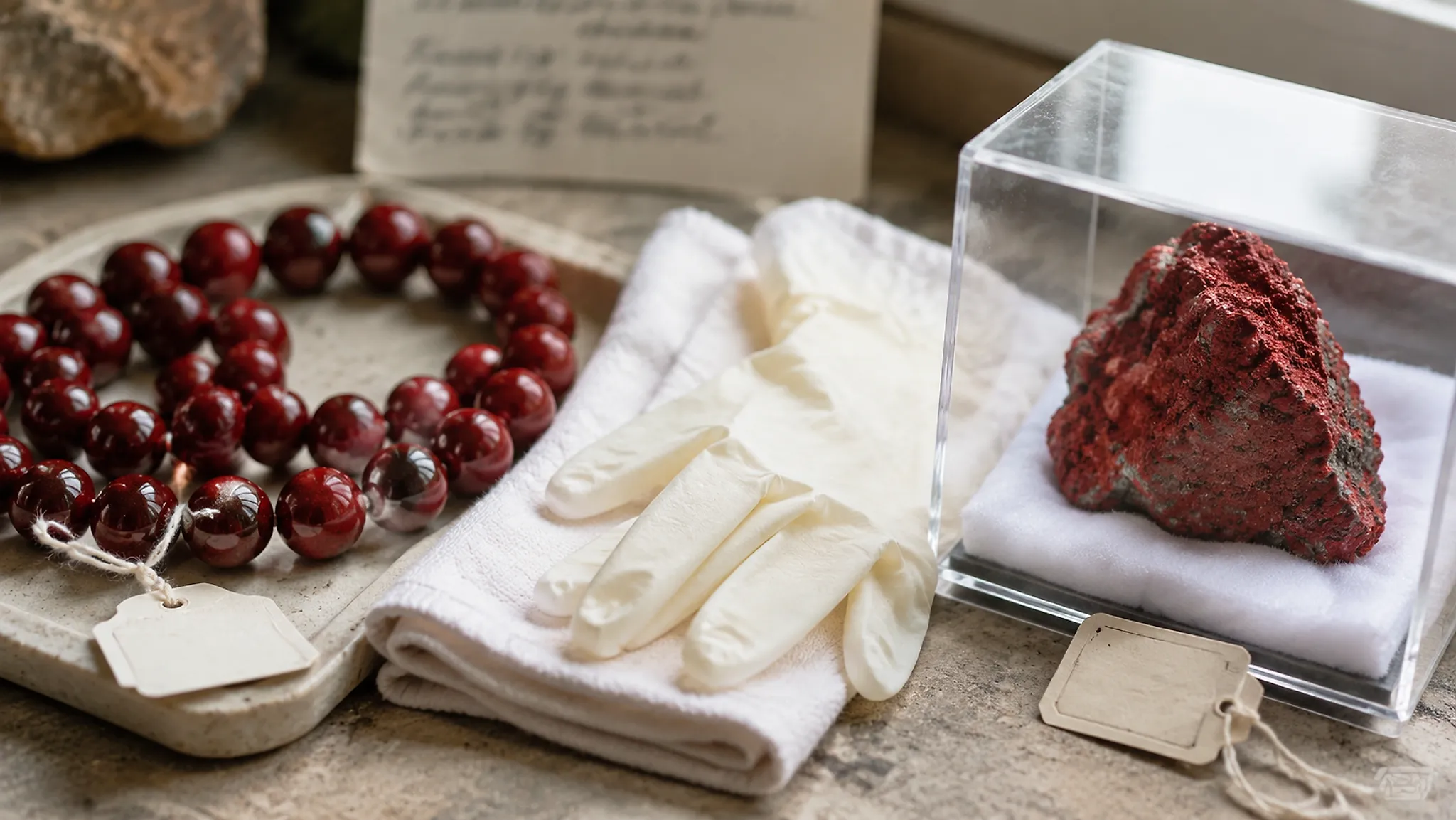
- Be more cautious with raw, powdery, damaged, flaking, or unsealed pieces.
- Keep uncertain cinnabar items away from children and pets.
- Wash hands after handling raw or dusty material.
These cautions do not mean every object sold as cinnabar has the same exposure profile. Form matters. A raw, crumbly specimen is different from a smooth sealed bead, and both are different from red resin sold under cinnabar-style wording. Condition matters too. A chipped, powdery, worn, or residue-leaving surface deserves more caution than an intact display piece kept behind glass.
The hard part is that a buyer usually cannot confirm coating quality or composition by sight. Seller reassurance is worth asking for, but it is still a claim. If the item will be worn often, handled by children, used near food, exposed to heat, or placed in water, the practical answer should become more conservative.
Raw Cinnabar Meaning vs Polished Cinnabar Meaning
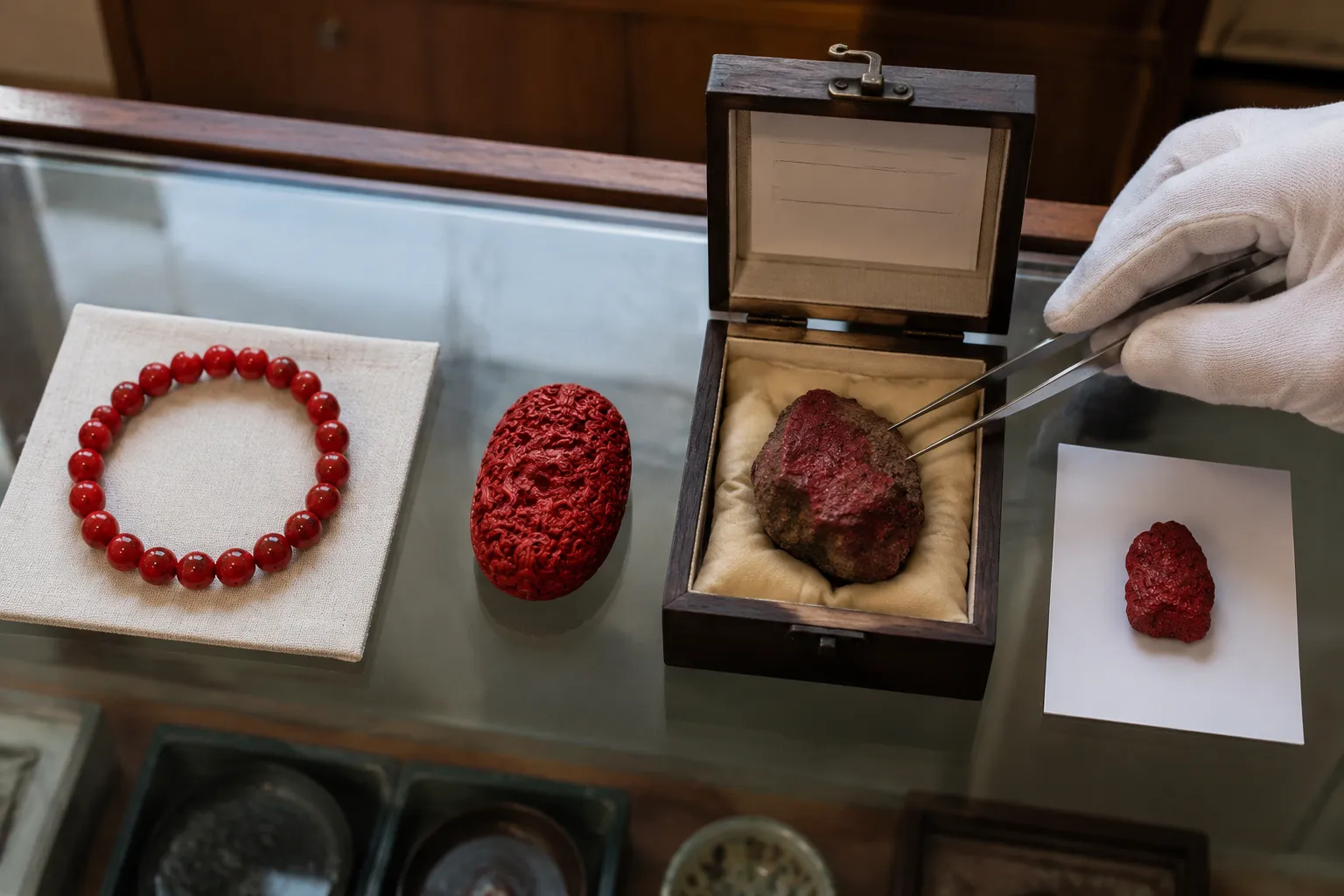
Raw cinnabar meaning often leans into mineral intensity: red ore, earthiness, direct material presence, and collector appeal. That same raw form is where handling boundaries become more important.
A raw specimen may have uneven surfaces, dust, matrix material, fragile areas, or exposed mineral faces. If it is powdery, damaged, or shedding, treat it as a display object: stable surface, minimal handling, no water use, no abrasion, no heat, and storage away from children and pets.
Polished cinnabar meaning usually shifts toward jewelry, talisman, charm, or decorative symbolism. A smooth bead or cabochon can look more wearable, but polish alone does not settle the material question. The object could be natural cinnabar, resin, composite, lacquer-style material, dyed stone, or a sealed mineral piece.
Raw specimen
Meaning often attached: mineral intensity, boundary symbolism, collector appeal. Main buyer question: is it stable, dusty, damaged, or exposed? Lower-contact choice: display in a case or on a fixed shelf.
Polished bead
Meaning often attached: wearable protection, luck, wealth, confidence. Main buyer question: what is the bead made of, and how is it finished? Lower-contact choice: occasional wear; avoid water and abrasion.
Carving or ornament
Meaning often attached: auspicious red, decorative charm, cultural symbolism. Main buyer question: is it mineral, resin, lacquer-style, dyed, or composite? Lower-contact choice: display use rather than constant handling.
Cinnabar-colored item
Meaning often attached: red symbolism without clear mineral identity. Main buyer question: is the name color-based or material-based? Lower-contact choice: choose it for color, not mineral certainty.
Raw and polished pieces can both carry meaning. Neither form proves identity or use suitability on its own.
Seller Words Buyers Should Check
Cinnabar seller listings often compress mineral terms, symbolic claims, and safety reassurance into a few lines. The words are not always wrong. They often answer different questions at once.
When a listing says “real cinnabar,” ask what “real” means. Natural mineral cinnabar? Powdered cinnabar in a composite? Cinnabar-colored resin? Lacquer-style material? Dyed stone? A coated bead? A vintage object with red pigment? Those are not interchangeable for handling or authenticity.
When a listing says “sealed,” ask what is sealed, what material was used, and whether the seller means a coating, stabilization process, or general surface finish. A sealed surface may reduce direct contact with the underlying material, but the word alone does not prove durability during wear.
When a listing leans on protection, wealth, confidence, or energy language, read it as meaning language. It may explain the intended symbolism. It does not answer the mineral question.
Useful buyer questions
- Is this natural cinnabar, cinnabar-colored material, resin, dyed stone, composite, lacquer-style material, or another red material?
- Is the piece raw, polished, coated, sealed, stabilized, or unsealed?
- Is the surface smooth and intact, or are there chips, dust, powder, flaking, worn areas, or residue?
- Is it intended for display, occasional wear, daily jewelry, or decorative storage?
- Can the seller explain the material without relying only on symbolic claims?
Even a clear answer from a seller remains a claim. For certainty, specialized testing may be needed.
Low-Contact Cinnabar Crystal Practice
Cinnabar symbolic use does not have to mean frequent skin contact. For many buyers, the cleanest compromise is a low-contact practice.
A display approach fits raw or uncertain pieces. Place the specimen where it will not be handled often, knocked over, heated, wetted, or reached by children or pets. If the piece is dusty or fragile, a small display box is more sensible than an open tray. The symbolism remains visible, while the handling demand stays low.
For jewelry, occasional careful wear is easier to defend than treating the item as an all-purpose daily piece. Avoid wearing cinnabar-like jewelry in the shower, during heavy sweating, while sleeping if it may rub or chip, or in any situation where it could be chewed, scratched, heated, or soaked. If the surface changes, flakes, cracks, or leaves residue, stop wearing it and reassess.
For intention-based use, avoid ingestion routes and water-contact practices. Do not place cinnabar in drinking water. Do not use it in oils, sprays, baths, or skin applications. A symbolic setup can use visual placement, a separate dish, a sealed container, or a written intention without transferring material onto the body.
This is not alarmist. It is a form-and-use decision.
How to Judge Cinnabar Crystal Meaning Without Overclaiming
A good cinnabar decision keeps three questions separate.
Meaning
What does the piece mean to you? If cinnabar represents boundary, auspicious red, prosperity symbolism, transformation, or focused intention, that can be a valid personal-use frame. The meaning does not need to become a testable result.
Object
What is the object likely to be? Look at color, finish, texture, surface condition, seller wording, and intended use. Bright red or brick-red color may fit cinnabar-like appearance, but visual cues only go so far. A red bead can be mineral, resin, dyed, composite, lacquer-style, or something else.
Use
How will it be used? Display, occasional handling, daily jewelry, water rituals, heat exposure, children, pets, and damaged surfaces are different scenarios. The same symbolic meaning may be acceptable in one use and a poor fit in another.
If you want the symbolism with fewer material questions, a cinnabar-colored object may be enough. If you want mineral cinnabar, buy with more caution, ask better questions, and avoid use patterns that increase contact, dust, heat, or ingestion concerns. If you want certainty about identity, appearance and seller language cannot provide it by themselves.
Cinnabar can be meaningful without being treated casually.
Cinnabar Meaning Boundaries for Crystal Buyers
The most useful boundary is not “wear it” or “never touch it.” It is more specific: match the form to the use, and do not let symbolic language override material caution.
Cinnabar crystal meaning belongs with personal symbolism, cultural association, feng shui language, and marketplace tradition. Cinnabar mineral precautions belong with mercury sulfide, surface condition, dust, heat, water use, and exposure route. They can sit beside each other, but one does not cancel the other.
Choose raw cinnabar only if you are comfortable treating it as a careful display material. Consider polished or sealed items only after asking what they are and how they are finished. Treat “natural,” “sealed,” “stabilized,” “Dragon’s Blood,” and “protective” as words to examine, not conclusions.
The practical buyer can check visible condition, seller wording, intended use, and handling habits. What remains uncertain is composition, coating quality, and long-term wear behavior without more specialized verification. That is the honest limit of a cinnabar meaning page.
Sources
Sources and further reading
Reference links are limited to sources considered suitable for public citation in this page.